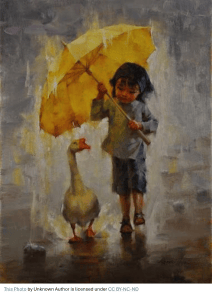
Doesn’t it feel a bit like Noah’s ark around here, fellow Iowans? Another early-morning thunderstorm has rolled through, and now everything is glistening. Even the rusting black railing around our front porch is shining. Rain can make almost anything look renewed, can’t it?
Meanwhile, our half-painted blue house sits there—waiting. The unfinished side, still white and dappled with bare spots from the power washer, seems to be waiting right along with us. Rain beads on the protective plastic covering the front windows and shutters. Our beautiful bay window has disappeared behind it all. So, what do we do? We sigh, watch the clouds, and wait for the painter to return.
Waiting at the Window
Then, a few days later, the painter finally removed the covering. Oh, what a happy day for our dear old Rascal! He had his favorite front window back—the place from which he faithfully guards the house. We open it just a little, and once again he can take in the world outside. His sight is limited now, and the dark street frightens him. But that familiar window? It helps him feel safe.
And isn’t that where many of us are sometimes—waiting at the window, hoping something will change? Patience is hard. We want answers now. We want the rain to stop, the work to begin, the door to open. But Scripture gently tells us, “Be still, and know that I am God” (Psalm 46:10). Breathe, friend. Our plans may not be God’s plans, and our timing may not be His timing. When we cannot see the whole path, we can still trust the One who can: “Trust in the Lord with all your heart and lean not on your own understanding” (Proverbs 3:5).
I see the same lesson when we walk Rascal. He may want to go straight ahead, but we can see a small hole in the path that he cannot. So we guide him around it. He may tug toward the direction he chose—perhaps wondering why we are stopping him—but we know what lies ahead. Could God be doing the same for us? A delay or redirection may feel frustrating, yet it may also be loving protection. “In all your ways submit to him, and he will make your paths straight” (Proverbs 3:6).
Safe in the Shepherd’s Care
Rascal has a way of accepting the day as it comes. He uses his other senses, loves his humans, and knows we love him. How does he know? By the gentle hands, the regular meals, the twice-daily walks, and the familiar voices telling him he is safe. He may fear what he cannot see, but he is surrounded by care.
Yes, he bumps his nose now and then. He misses a step. His legs are a little frail. But Rassy shakes it off! He runs, barks, plays, eats, drinks, and goes looking for the next wonderful sniff on our walks. Watching him reminds me that weakness and uncertainty do not erase the goodness still right in front of us.
Friend, God offers us that same steady presence: “Do not fear, for I am with you” (Isaiah 41:10). That promise does not mean every delay will suddenly make sense. It means we are not abandoned while we wait. We are seen. We are guided. We are loved. And as Isaiah 40:31 reminds us, those who hope in the Lord will renew their strength.
Grace for This Day
Our friends in the South are praying for rain, while here in Iowa we might gladly box up a few clouds and send them along! Isn’t it interesting? What feels like an interruption to one person may look like an answered prayer to another. Maybe that is one gift hidden in the waiting: we learn to hold our plans a little more loosely, notice the blessings already around us, and trust that God is working beyond what we can see.
Lord, when I cannot see the way ahead, help me trust Your loving guidance. Give me patience in the delays, courage in uncertainty, and gratitude for today’s small joys. Remind me that I am safe in Your care—and that I am never alone. Amen.
© 2026 Bonnie L. Smith-Davis